Primary school completion in India, 1950-2000
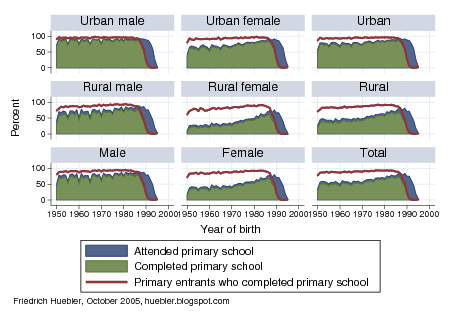
The share of the Indian population who attended school has increased steadily over the past 50 years. Data on educational attainment in India shows that about 80% of all persons born around 1990 have attended at least primary school. Of the generation born between 1950 and 1970, only about 55% ever attended school.
Not every child who enters primary school completes that level of education. High dropout rates are a particular concern in Sub-Saharan Africa, the region with the lowest school life expectancy values worldwide. In India, on the other hand, most children who enter the first grade stay in primary school until they graduate after five years of education. The graph below compares the percentage of Indians who attended primary school (independent of the number of years) with the percentage who completed primary education between 1950 and 2000. The data, from a 2000 Multiple Indicator Cluster Survey (MICS), is disaggegrated by sex and area of residence.
Primary school attendance and completion by year of birth, India 1950-2000
Data source: India 2000 MICS.
The population is grouped by year of birth and for each cohort three values are shown:
The education system in India succeeds at keeping children in school. Children currently out of school are therefore likely to complete at least the primary level of education once they take the crucial step of enrolling in the first grade. A disaggregation of primary school attendance rates in India makes clear that many of the children out of school are girls from poor rural households. Educators and policy makers have to focus their efforts on this group of children to reach the Millennium Development Goal of universal primary education.
Related articles
Friedrich Huebler, 18 October 2005 (edited 12 October 2008), Creative Commons License
Permanent URL: http://huebler.blogspot.com/2005/10/primary-school-completion-in-india.html
Not every child who enters primary school completes that level of education. High dropout rates are a particular concern in Sub-Saharan Africa, the region with the lowest school life expectancy values worldwide. In India, on the other hand, most children who enter the first grade stay in primary school until they graduate after five years of education. The graph below compares the percentage of Indians who attended primary school (independent of the number of years) with the percentage who completed primary education between 1950 and 2000. The data, from a 2000 Multiple Indicator Cluster Survey (MICS), is disaggegrated by sex and area of residence.
Primary school attendance and completion by year of birth, India 1950-2000
Data source: India 2000 MICS.
The population is grouped by year of birth and for each cohort three values are shown:
- the percentage who attended primary school or higher (blue area)
- the percentage who completed primary school (green area)
- the percentage of primary entrants who completed primary school (ratio completed primary/attended primary, red line)
The education system in India succeeds at keeping children in school. Children currently out of school are therefore likely to complete at least the primary level of education once they take the crucial step of enrolling in the first grade. A disaggregation of primary school attendance rates in India makes clear that many of the children out of school are girls from poor rural households. Educators and policy makers have to focus their efforts on this group of children to reach the Millennium Development Goal of universal primary education.
Related articles
Friedrich Huebler, 18 October 2005 (edited 12 October 2008), Creative Commons License
Permanent URL: http://huebler.blogspot.com/2005/10/primary-school-completion-in-india.html


Comments
Post a Comment