Posts

Showing posts from October, 2005

Primary school attendance in Nigeria
Image
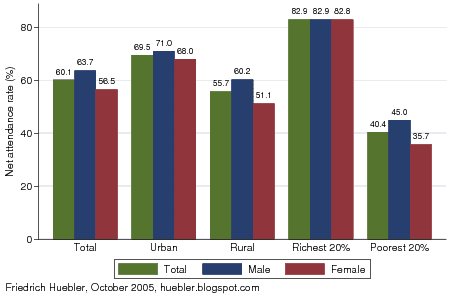
Nigeria is one of UNICEF's 25 priority countries for girls' education . In the year 2005, the population of Nigeria is estimated to be 130 million, which makes it the most populous country in Africa. 22 million children are 6 to 11 years old, the official primary school age in Nigeria. The most recent data on school attendance in Nigeria comes from a Demographic and Health Survey (DHS) that was conducted in 2003. 60.1% of all children of primary school age were attending primary school at the time of the survey. Boys had a higher net attendance rate (NAR) than girls, with 63.7% compared to 56.5% for girls. Primary school net attendance rate, Nigeria 2003 Data source: Nigeria 2003 DHS. Children in urban areas had a higher primary NAR (69.5%) than children in rural areas (55.7%). The disparity between children from the richest and poorest households was even greater. In the richest 20% of all households, 82.9% of all children of primary school age attended primary school. In the ...
UNICEF priority countries for girls' education

Image
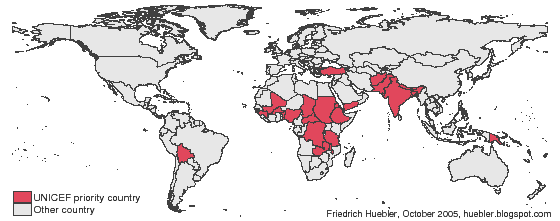
Two of the UN Millennium Development Goals address education: Goal 2: Achieve universal primary education Goal 3: Promote gender equality and empower women Goal 3 states further that gender disparity in primary and secondary education was to be eliminated preferably by 2005 and at all levels of education no later than 2015. Data on school attendance in 2005 is not yet available but recent estimates make clear that a large gender gap continues to exist in many countries, especially in South Asia and Sub-Saharan Africa. UNICEF has identified 25 priority countries to reduce the number of girls currently out of school. The 25 countries are Afghanistan, Bangladesh, Benin, Bhutan, Bolivia, Burkina Faso, Central African Republic, Chad, Democratic Republic of Congo, Djibouti, Eritrea, Ethiopia, Guinea, India, Malawi, Mali, Nepal, Nigeria, Pakistan, Papua New Guinea, Sudan, Tanzania, Turkey, Yemen and Zambia. UNICEF priority countries for girls' education The countries, highlighted in the...

Primary school completion in India, 1950-2000

Image
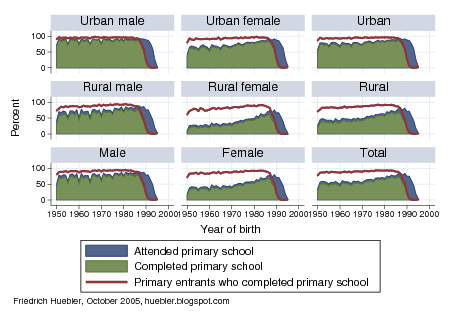
The share of the Indian population who attended school has increased steadily over the past 50 years. Data on educational attainment in India shows that about 80% of all persons born around 1990 have attended at least primary school. Of the generation born between 1950 and 1970, only about 55% ever attended school. Not every child who enters primary school completes that level of education. High dropout rates are a particular concern in Sub-Saharan Africa, the region with the lowest school life expectancy values worldwide. In India, on the other hand, most children who enter the first grade stay in primary school until they graduate after five years of education. The graph below compares the percentage of Indians who attended primary school (independent of the number of years) with the percentage who completed primary education between 1950 and 2000. The data, from a 2000 Multiple Indicator Cluster Survey (MICS), is disaggegrated by sex and area of residence. Primary school attendanc...

Educational attainment in India, 1950-2000

Image
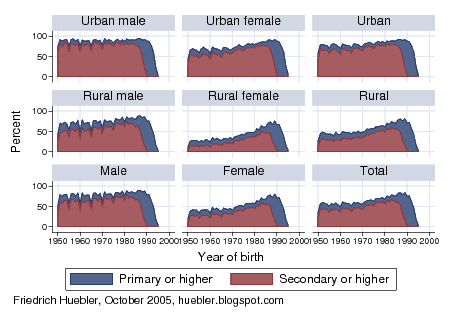
India is well on the way to achieving the Millennium Development Goal of universal primary education by the year 2015. In spite of rapid population growth during the last 50 years, India has managed to expand its education system to reach an ever larger part of the population. The increase in educational attainment since 1950 can be traced with data from a Multiple Indicator Cluster Survey (MICS) that was conducted in India in 2000. This nationally representative household survey collected data on the education of all household members aged 5 years or older. The data indicates whether a person attended school, at which level, and for how many years. By grouping all household members by year of birth we can calculate the percentage of a cohort that has attended - but not necessarily completed - a certain level of education. The graph below plots these values for all persons born between 1950 and 2000, disaggregated by sex and area of residence. Educational attainment by year of birth...

Guide to reading Statalist with Gmail

Statalist is a mailing list for users of the Stata statistical package. To subscribe to Statalist, send an e-mail message to majordomo@hsphsun2.harvard.edu , with the text " subscribe statalist " (without quotes) in the body of the message. In Gmail all messages are displayed with a variable-width font by default. This can make Statalist messages hard to read if they contain tables that only lign up properly with a fixed-width font. Here is a typical Stata table: Variable | Obs Mean Std. Dev. Min Max -------------+-------------------------------------------------------- age | 11258 10.46394 2.277534 7 14 school | 11209 .7712552 .4200433 0 1 In Gmail the same table would be displayed like this:     Variable |       Obs        Mean    Std. Dev.   ...