Posts

Showing posts from October, 2008

Pupil/teacher ratio in primary school
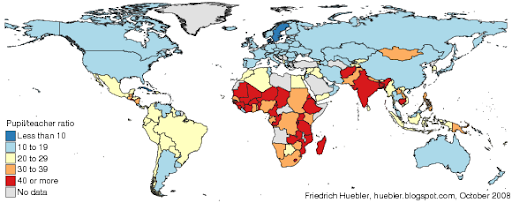
Image
Global primary school attendance rates have been on a steady upward trend over the past years. As the world moves closer to the goal of universal primary education , the issue of education quality attracts increasing attention. One measure of education quality is the pupil/teacher ratio, the number of pupils per teacher in a school. Teachers of a large class can dedicate less time to each pupil than in a small class. For the pupils, crowded classrooms make it difficult to concentrate on the material and to learn. The results of overcrowding are lower academic achievement and increased dropout rates. The map below displays the pupil/teacher ratio in primary school in 194 countries and territories for which data were available. The data were obtained from the UNESCO Institute for Statistics. For 124 countries, the pupil/teacher ratios are from 2006, 12 countries have data from 2007, 42 countries have data from 2004 or 2005, and the remaining 16 countries have data from 1999 to 2003. For ...

UN Millennium Development Goals Report 2008

Image
In August 2008, the United Nations published the latest edition of its annual report on progress toward the Millennium Development Goals (MDG). The Millennium Development Goals Report 2008 presents data for each of the eight MDGs. Eradicate extreme poverty and hunger Achieve universal primary education Promote gender equality and empower women Reduce child mortality Improve maternal health Combat HIV/AIDS, malaria and other diseases Ensure environmental sustainability Develop a global partnership for development In the section on MDG 2, universal primary education, trends in primary school enrollment from 1991 to 2006 are shown for each MDG region . One region, the Commonwealth of Independent States, is further divided into countries in Europe and Asia. No data are provided for the Oceania region. Primary school net enrollment rate, 1991-2006 Source: United Nations, The Millennium Development Goals Report 2008 , page 12. Six MDG regions have reached primary school net enrollment rate...

Education disparity in South Asia

Image
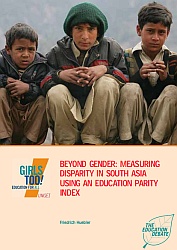
A new publication by Friedrich Huebler describes education disparity in the countries of South Asia. The report Beyond gender: Measuring disparity in South Asia using an education parity index was published by the UNICEF regional office for South Asia in its series of papers on girls' education . Analysis of disparities in national education systems is often limited to gender although other dimensions of disparity are also important. The publication presents data on disparity in primary and secondary education by gender, area of residence and household wealth for countries in South Asia. To facilitate the interpretation of complex data a newly developed Education Parity Index is introduced. The EPI combines information on disparities across different education indicators and across different groups of disaggregation. This distinguishes the EPI from existing indicators of disparity in education, including the gender parity index and the EFA development index. The EPI is flexible a...

Child labor and school attendance

Image
A previous article on child labor on this site presented a definition of child labor that considers both economic activity and household chores. The inclusion of household chores leads to a more precise measure of the burden of work on children. In particular, this new child labor indicator is less biased against girls, who typically spend more time on household chores and less time on economic activity than boys. In the graph below, the proposed child labor indicator is used to evaluate the trade-off between child labor and school attendance among children aged 7 to 14 years in 35 developing countries. This age group was selected because in all 35 countries children are expected to enter primary school by age 7. The underlying data were collected with 26 Multiple Indicator Cluster Surveys (MICS) and 9 Demographic and Health Surveys (DHS) between 1999 and 2005. 34 of the surveys are nationally representative and one, Palestinians in Syria, is a subnational sample. Surveys conducted ...