Posts

Showing posts from April, 2008

Guide to integrating Stata and external text editors

Image
Last update: 28 June 2017 Download links For Stata 14 and 15 (with Unicode support): rundolines51.zip (412 KB), updated 28 June 2017 rundo51.zip (412 KB), updated 28 June 2017 For Stata 13.1 and older versions of Stata (without Unicode support): rundolines41.zip (243 KB), updated 22 December 2013 rundo41.zip (242 KB), updated 22 December 2013 Table of contents 1. Introduction 2. Requirements 3. Installation 4. Using the programs 5. Known problems and troubleshooting 6. Acknowledgments 7. History of the programs 1. Introduction Stata is a statistical package that is available for Windows, Macintosh and Unix operating systems. This guide addresses some shortcomings of the text editor that is part of the Stata package. Stata's Do-File Editor is fully integrated and commands can be executed directly from the editor with a keyboard shortcut or the click of a button. External editors often have a richer set of features but they lack integration with Stata. This document descr...
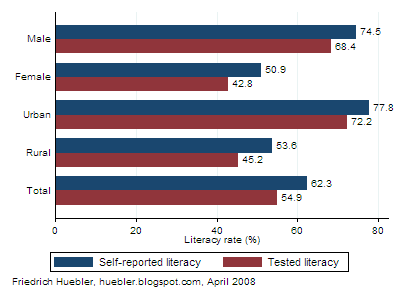
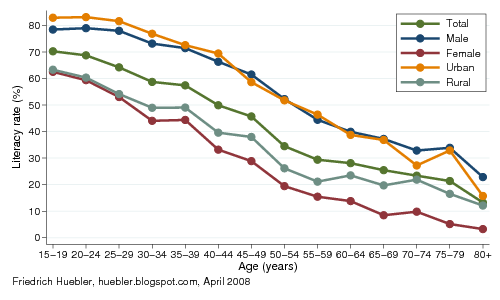
Reported and tested literacy in Nigeria

Image
Household surveys like the Demographic and Health Surveys (DHS) or the Multiple Indicator Cluster Surveys (MICS) collect data on literacy with various methods. One approach is to simply ask respondents whether they can read and write. In an alternative approach, the reading ability is tested by asking respondents to read a sentence from a card. More detailed assessments of literacy, such as the National Assessment of Adult Literacy in the United States, require in-depth questionnaires that are beyond the scope of surveys like the DHS and MICS. The Nigeria DHS of 2003 collected literacy data with two methods. First, the survey questionnaire contained the question: "Can (name) read and write in any language with understanding?" This question was asked for all household members aged 5 years and older, with two possible answers: yes or no (NPC and ORC Macro 2004: 247). The results of this literacy assessment were described in the article " Adult literacy in Nigeria ...

Adult literacy in Nigeria

Image
The adult literacy rate is the share of literate persons in the population aged 15 years and older. In Nigeria, a Demographic and Health Survey (DHS) collected data on literacy that can be disaggregated by age, gender, area of residence, and other characteristics. In the survey, conducted in 2003, literacy is defined as the ability to "read and write in any language with understanding" (NPC and ORC Macro 2004: 247). To collect this data, respondents were only asked whether they are literate, but no reading or writing tests were applied. A smaller group of respondents, all women aged 15-49 years and one third of men aged 15-59 years, were asked to read a simple sentence in any of the major language groups of Nigeria (NPC and ORC Macro 2004: 26-27). The literacy rates obtained from this separate reading test were not considered for the analysis that follows, but they are lower than the self-reported literacy rates that cover all survey respondents aged 5 years and older. A se...