Posts

Showing posts from January, 2008

The State of the World's Children 2008 by UNICEF

Image
UNICEF released the 2008 edition of its annual publication The State of the World's Children on 22 January 2008. This year's report is dedicated to child survival and primary health care for children and their mothers. In 2006, 9.7 million children died before they reached their fifth birthday. In spite of improvements in the area of child survival, the world is not on track to reach the Millennium Development Goal of reducing the rate of child mortality by two thirds between 1990 and 2015. The State of the World's Children contains statistical tables with national data on nutrition, health, HIV and AIDS, education, demography, economy, women, and child protection. In the area of education, the report lists data for the following indicators: Primary school enrollment and attendance Secondary school enrollment and attendance Survival rate to grade 5 Youth and adult literacy The tables in The State of the World's Children complement the statistical review Progress for...
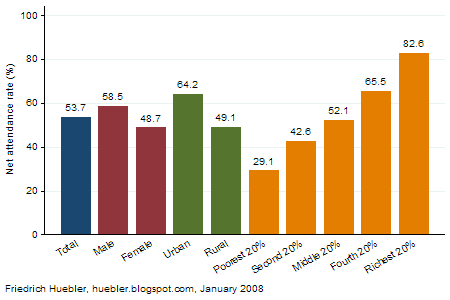
Secondary school attendance in India in 2006

Image
In India, 83 percent of all children of primary school age (6-10 years) attend primary school , as described in a previous article on this site. Primary school net attendance rates (NAR) are highest in urban areas and among children from the richest households. Fewer children continue their education at the secondary level. Data from a nationally representative Demographic and Health Survey (called National Family Health Survey in India) conducted in 2005 and 2006 shows that only 54 percent of all children of secondary school age (11-17 years) attend secondary school. In addition, there are large disparities between different groups of children, as the graph below demonstrates. Boys and children from urban areas are more likely to be in secondary school than girls and children from rural areas. Secondary school net attendance rate (NAR), India 2006 Data source: India Demographic and Health Survey 2005-06. The biggest disparities exist between children from different wealth quintiles. ...

Universal primary education by 2015: A goal out of reach?

Image
The new UNICEF publication Progress for Children compares data on children out of school by UNESCO and UNICEF. According to UNESCO, 72 million children of primary school age were out of school in 2005, down from 96 million in 1999. UNICEF estimates that 93 million children were out of school in 2005/2006, down from 115 million in 2002. Although both sets of data show a decline in the number of children out of school, they also indicate that the Millennium Development Goal of universal primary education by 2015 may be out of reach. The graph below plots trend data on the number of children out of school calculated by UNESCO for the period 1999-2005 and by UNICEF for the period 2002-2006. (The 2002 estimate in the latter trend line is based on joint work by UNICEF and the UNESCO Institute for Statistics.) If we assume that the reduction in the number of children out of school continues at the same average rate as over the past years, more than 30 to 40 million children will still be ou...