Posts

Showing posts from December, 2007

UNICEF statistical review: Progress for Children
Image
On 10 December 2007, UNICEF launched a new publication, Progress for Children: A World Fit for Children Statistical Review . With more than 60 pages of graphs and tables, the report draws a detailed statistical picture of the current state of the world's children. The publication is divided into sections organized by Millennium Development Goal . MDG 1: Eradicate extreme poverty and hunger MDG 2: Achieve universal primary education MDG 3: Promote gender equality and empower women MDG 4: Reduce child mortality MDG 5: Improve maternal health MDG 6: Combat HIV and AIDS, malaria and other diseases MDG 7: Ensure environmental sustainability An additional section has data on protection against abuse, exploitation, and violence. Some findings of the report in the area of education are: The number of children out of school has fallen from 115 million in 2002 to 93 million in 2005-2006. More than three quarters of all children out of school worldwide live in Sub-Saharan Africa and South As...
Primary school attendance by state in India

Image
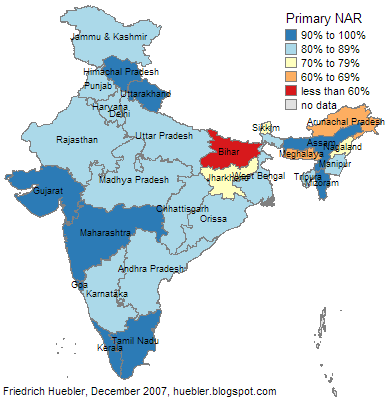
The average primary school net attendance rate in India is 83 percent according to data from a Demographic and Health Survey (DHS) conducted in 2005 and 2006. However, the national average hides considerable regional variation in primary school attendance. India is divided into 28 states and 7 union territories . With the DHS data it is possible to calculate the primary school NAR in 29 states and territories, shown in the map and table below. Primary school attendance in India by state and territory, 2006 Data source: India DHS 2005-06 The states with the highest primary school net attendance rates, between 98 and 99 percent, are Himachal Pradesh, Kerala, and Tamil Nadu. In these states, virtually all children of primary school age are in school. Six other states also have primary NAR values above 90 percent: Assam, Goa, Gujarat, Maharashtra, Mizoram, and Uttarakhand. In fifteen states and territories the primary NAR is between 80 and 90 percent. In six states, fewer than four out of...

EFA Global Monitoring Report 2008

Image
On 29 November 2007, UNESCO released the 2008 edition of the annual Education for All Global Monitoring Report , with the title Education for All by 2015: Will we make it? The report, now in its sixth edition, monitors progress towards the six Education for All goals adopted at the World Education Forum in Dakar, Senegal in 2000: Expand and improve early childhood care and education. Provide free and compulsory universal primary education by 2015. Equitable access to learning and life-skills programs. Achieve a 50% improvement in adult literacy rates. Eliminate gender disparities in primary and secondary education by 2005 and at all levels by 2015. Improve all aspects of the quality of education. Some highlights of the 2008 report are: Between 1999 and 2005, primary school enrollment rose from 647 million to 688 million worldwide. The rate of increase was particularly high in Sub-Saharan Africa and in South and West Asia. As a result, the global number of children out of school fell f...