Posts

Showing posts from July, 2007

UN Millennium Development Goals Report 2007
Image
In June 2007, the United Nations published the latest edition of its annual report on progress toward the Millennium Development Goals (MDG). The Millennium Development Goals Report 2007 presents data for each of the eight MDGs. Eradicate extreme poverty and hunger Achieve universal primary education Promote gender equality and empower women Reduce child mortality Improve maternal health Combat HIV/AIDS, malaria and other diseases Ensure environmental sustainability Develop a global partnership for development In the section on MDG 2, the achievement of universal primary education, the report shows trends in primary school enrollment from 1991 to 2005. The statistics are presented by MDG region . One region, the Commonwealth of Independent States, is further divided into countries in Europe and Asia. Primary school net enrollment rate, 1991-2005 Source: United Nations, The Millennium Development Goals Report 2007 , page 10. Seven regions have reached primary school net enrollment rat...
Disparity between adult and youth literacy

Image
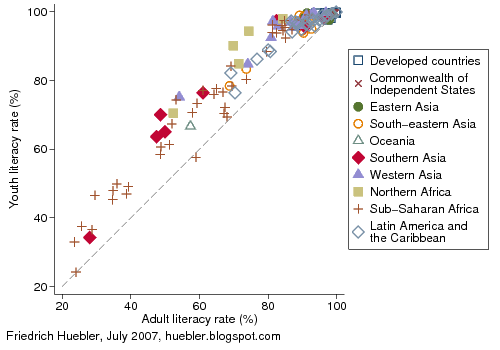
Two recent articles on this web site present the latest data from the UNESCO Institute for Statistics (UIS) on adult literacy and youth literacy worldwide. The adult literacy rate refers to the population aged 15 years and over, the youth literacy rate to the population aged 15 to 24 years. Youth literacy is generally higher than adult literacy, due to increasing levels of school attendance over the past decades. The scatter plot in Figure 1 compares adult and youth literacy in 133 countries with data. The adult literacy rate is plotted along the horizontal axis and the youth literacy rate along the vertical axis. Almost all countries are located above the 45 degree line in the graph, which means that youth literacy is higher than adult literacy. Countries with no difference between the two literacy rates are located along the 45 degree line. Figure 1: Adult and youth literacy: all countries with data Source: UNESCO Institute for Statistics, Data Centre, June 2007. Many countries ar...

Youth literacy rates

Image
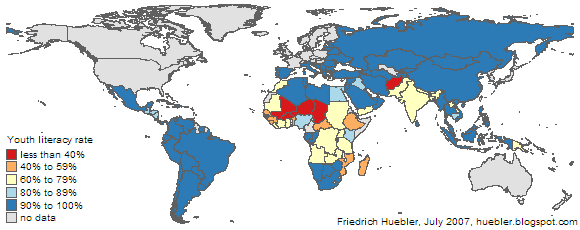
Last week, I posted an article on adult literacy with the latest statistics from the UNESCO Institute for Statistics (UIS) . Today's article will look at the latest statistics on youth literacy. The youth literacy rate is the share of the population aged 15 to 24 years that is literate. UNESCO provides national data on youth literacy for 133 countries. This compares to 137 countries for which the adult literacy rate is known. The youth literacy rate is usually higher than the adult literacy rate, especially in developing countries where the education system has expanded over the past decades. In a country where school attendance rates increase over time, persons born in a later year are more likely to attend school and to become literate. The map below displays the youth literacy rate for each country with data, ranging from 24.2 percent in Mali to 100 percent in Cuba. Most industrialized countries have no data on youth literacy, but school attendance is almost universal in these ...

Adult literacy rates

Image
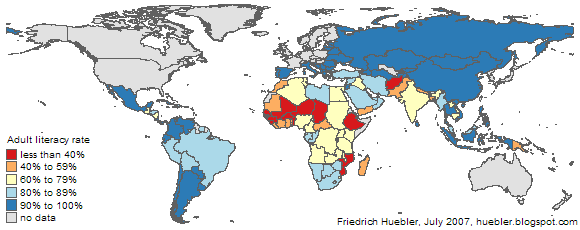
In June 2007, the UNESCO Institute for Statistics (UIS) released its latest literacy statistics, covering the years 1985 to 2005. In a change from literacy statistics released in previous years, UIS only reports on observed literacy and no longer uses proxy variables like educational attainment . The UIS database contains two sets of literacy rates: Youth literacy rate: the share of the population aged 15 to 24 years that is literate. Adult literacy rate: the share of the population aged 15 years and older that is literate. Both literacy rates are reported at the national and regional level. The adult literacy rate is available for 137 countries, shown in the map below. It ranges from 23.6 percent in Burkina Faso to 99.8 percent in Cuba. For 71 countries, the adult literacy rate is unknown but most of these countries are industrialized and literacy can therefore be assumed to be at a high level. Adult literacy rates by country Source: UNESCO Institute for Statistics, Data Centre, June...