Years of schooling and literacy: Can everyone with primary education read and write?
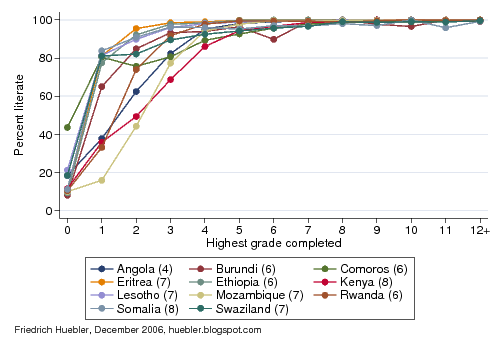
The 2007 edition of the Education for All Global Monitoring Report was released by UNESCO in October 2006. The report assesses progress toward the goal of basic education for all children and adults by 2015 with the EFA Development Index (EDI). A previous article on this site describes how the EDI is calculated . One component of the EDI is the adult literacy rate. The adult literacy rate usually indicates the share of literate persons in the population aged 15 years and older. In countries, where the literacy rate is not available, a proxy measure is substituted for the calculation of the EDI. This proxy measure is the share of the adult population with at least a complete primary education (UNESCO 2006, p. 201, note 2). To evaluate whether this proxy is indeed a good substitute for the adult literacy rate, it is necessary to know if all children with a complete primary education can in fact be considered literate. Various household surveys collect data on literacy, among them the M...
