Household wealth and school attendance in Nigeria
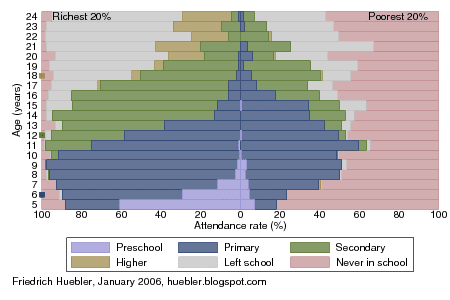
In 2003, a Demographic and Health Survey (DHS) was conducted in Nigeria. This nationally representative household survey collected data on household characteristics, education, maternal and child health, family planning, and other indicators. The survey has no data on household income but with the information on assets owned by a household - for example, water supply, sanitation facilities, housing material, radio, telephone, refrigerator, bicycle, automobile, and livestock - it is possible to generate an index of relative household wealth (Filmer and Pritchett 2001). With this index, the link between wealth and the level of education of each household member can be analyzed. The primary school age in Nigeria is 6 to 11 years and the secondary school age 12 to 17 years. As I showed in previous posts, the primary school net attendance rate (NAR) in Nigeria is 60.1% and the secondary school NAR 35.1%. This means that 60.1% (35.1%) of all children of primary (secondary) school age were...