Posts

Showing posts from September, 2005

Secondary school attendance in India
Image
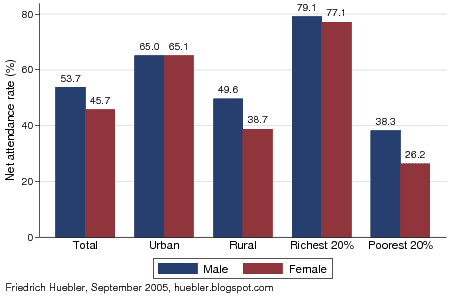
A Multiple Indicator Cluster Survey (MICS) that was conducted in India in 2000 showed that 72.1% of all children of primary school age (6-10 years) were attending primary school. (A previous post on this site has more details on primary school attendance in India .) Only two thirds of these children continue their education at the secondary level. Among children of secondary school age (11-17 years), 49.7% were in secondary school at the time of the MICS survey. A comparison of primary and secondary school net attendance rates (NAR) reveals that virtually all primary school children from the richest 20% of all households go on to attend secondary school. For children from the poorest 20% of all households, the NAR drops from 64.0% at the primary level to 32.3% at the secondary level. Rural children are also much less likely to stay in school than urban children. Secondary school net attendance rate, India 2000 Data source: India 2000 MICS. The gender disparity that can be observed at ...
National wealth and school enrollment

Image
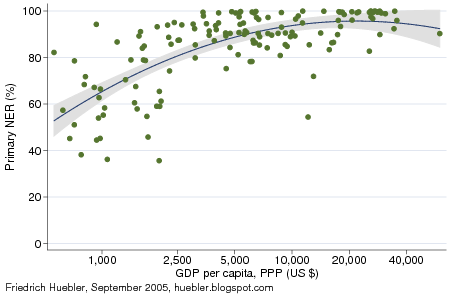
The first and second goal of the Millennium Development Goals are the eradication of extreme poverty and hunger and the achievement of universal primary education. In previous posts I presented evidence on the connection between poverty and education in India and the United States . At the global level, this link is also evident. Middle and high income countries typically have higher levels of school enrollment than low income countries. This relationship can be demonstrated by plotting school net enrollment ratios (NER) against gross domestic product (GDP) per capita as a measure of national wealth. The graphs below present the primary and secondary school NER in 2002/03 (the latest year with data) in relation to GDP per capita in 2002. School enrollment figures are from the Global Education Digest 2005 by UNESCO and the GDP per capita from the World Development Indicators 2005 by the World Bank. The GDP data was adjusted with purchasing power parities (PPP) to take the price le...